
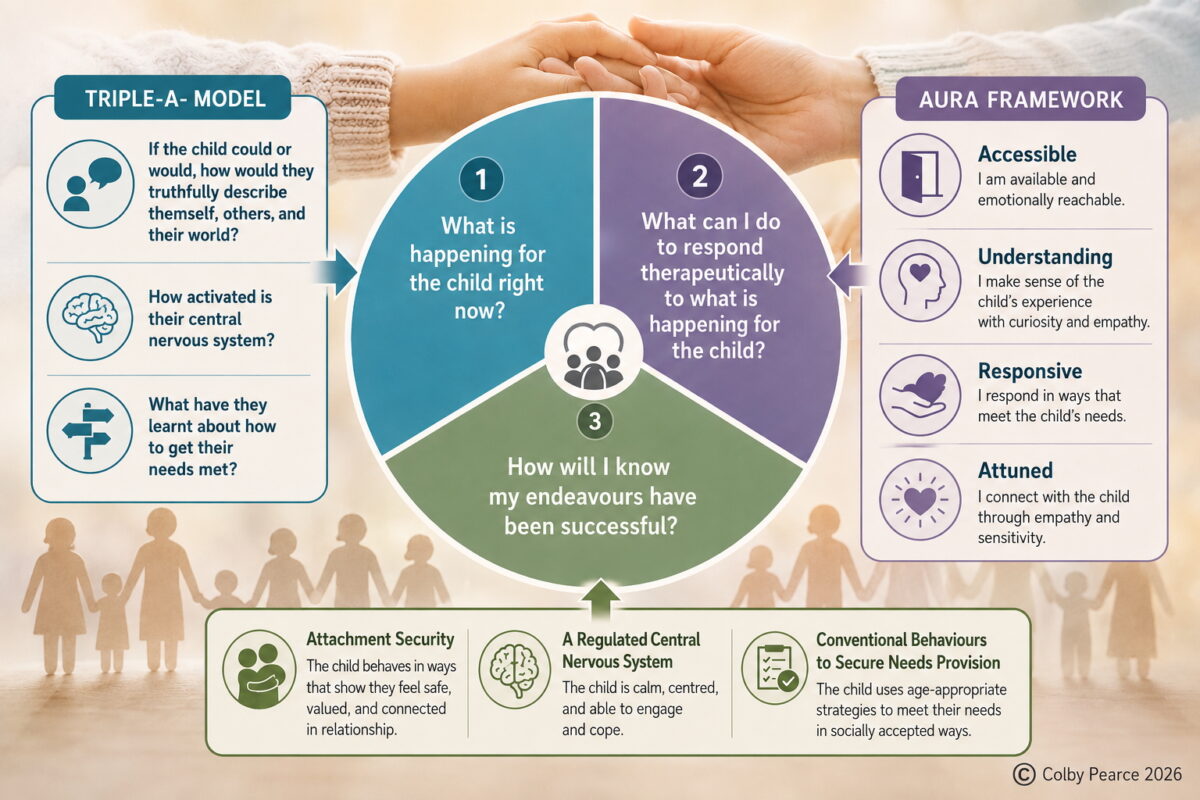
Evidence-informed. Practice-tested. Transparently evaluated. Triple-A brings attachment, regulation, learning and therapeutic caregiving together in a practical Model of Care.
The evidence and practice foundation of Triple-A
The Triple-A Model of Therapeutic Care is an evidence-informed framework designed to help caregivers and organisations understand children affected by adversity and respond in ways that are therapeutic, relational and developmentally informed.
Triple-A has a peer-reviewed conceptual foundation, more than a decade of real-world implementation in Australia and Ireland, and preliminary direct evaluation demonstrating high acceptability and promising practice-based outcomes. Its principles have also informed large-scale implementation within the South Australian child protection system.
Further independent research is required to establish the effectiveness of the contemporary Triple-A Model itself and its child-level outcomes.
From understanding to therapeutic responding
At the centre of Triple-A are two complementary frameworks. AAA helps caregivers consider what may be happening for the child through three domains: Attachment, Arousal, and Accessibility to needs provision. AURA then turns understanding into therapeutic responding by directing attention to whether caregiving is Accessible, Understanding, Responsive and Attuned.
The aim is not to diagnose children or reduce complex behaviour to a single explanation. Triple-A provides a practical framework for curiosity, reflection and therapeutic caregiving in the ordinary moments of everyday care.
A published conceptual foundation
The foundational Triple-A approach was published by Colby Pearce in Educational and Child Psychology in 2010. The paper integrated attachment theory, developmental and neurobiological knowledge, learning theory and reflective clinical practice. It described the three domains that became AAA and also identified caregiver accessibility, understanding, responsiveness and affective attunement – the conceptual antecedents of the contemporary AURA framework.
More than a decade of implementation
Triple-A has developed through more than a decade of application in real-world child and family services in Australia and Ireland.
In 2014, Triple-A was implemented within Centacare’s Family Preservation Foster Care Service in South Australia. Outcome data were collected during that implementation but are not publicly reported because permission for their disclosure has not been obtained.
In 2015–2016, Triple-A was formally implemented with TUSLA (Child and Family Agency) foster carers and professional staff in County Donegal, Ireland. The implementation was supported and funded by TUSLA and included professional staff preparation, five weekly foster-carer workshops, therapeutic caregiving content, caregiver self-care, and a monitoring and evaluation process.
The preliminary Donegal evaluation reported consistently high participant acceptability. Across both implementation locations and all five weeks, 100% of respondents reported that the programme had been communicated effectively and 100% said they would recommend it to others. The evaluation also contained promising preliminary child-level practice data, while acknowledging important methodological limitations.
From pilot to organisational embedding in Donegal
The Donegal experience did not end with the initial pilot. A later TUSLA Donegal Fostering Service Training Needs Analysis, prepared in the context of a HIQA inspection Action Plan concerning foster-carer training, documented Triple-A/AAA as commissioned mandatory training within the service’s rolling foster-carer training programme.
This provides evidence of organisational embedding within TUSLA Donegal. It should not be interpreted as a claim that HIQA approved, endorsed or validated Triple-A.
Large-scale implementation in South Australia
Between 2018 and 2020, Triple-A principles were incorporated into the Kinship CARE Project, a two-year initiative delivered by Secure Start with the support of the South Australian Department for Child Protection.
The completed project reached 250 kinship carers across 24 metropolitan and regional locations. Among carers completing the training and three-month follow-up survey:
- 84% reported improved relationships with children in their care.
- 89% reported greater confidence in their role as a kinship carer.
- 98% reported learning helpful strategies.
- 100% reported receiving helpful information.
Pre- and post-training data also indicated a shift in how carers understood children’s behaviour, with carers more than twice as likely after training to understand behaviour as an expression of needs rather than simply as “naughtiness”.
The CARE framework was a contextualised implementation drawing explicitly upon Triple-A rather than an evaluation of the contemporary Triple-A Model as a whole. Its findings therefore provide related practice and implementation evidence rather than direct evidence of Triple-A effectiveness.
From 2021 to 2024, the Kinship CARE approach continued through the Martinthi Aboriginal Kinship CARE Program in South Australia. This period contributes to the history of implementation and contextual adaptation of CARE and Triple-A principles, but is not presented here as outcome evidence.
What the evidence currently supports
- Triple-A has a peer-reviewed conceptual foundation.
- Triple-A has more than a decade of real-world implementation across Australian and Irish child and family services.
- The Donegal pilot demonstrated high acceptability and perceived usefulness among participating foster carers.
- The Donegal evaluation produced promising preliminary practice-based child-level data.
- TUSLA documentation shows that Triple-A moved beyond the initial Donegal pilot into ongoing foster-carer training arrangements.
- Triple-A was implemented within a South Australian family preservation foster care service as early as 2014.
- A contextualised framework explicitly incorporating Triple-A was subsequently implemented at scale within South Australia’s kinship care system, providing additional practice-based evidence concerning caregiver learning, confidence, relationships and system-level implementation.
- CARE and Triple-A principles continued to be applied in a subsequent Aboriginal kinship care context through the Martinthi program.
The current evidence does not establish that Triple-A causes particular child or service outcomes, nor does it justify describing AAA or AURA as validated assessment instruments. Triple-A is therefore described as evidence-informed rather than as an independently proven intervention.
Training is not implementation
Triple-A distinguishes learning the Model from actually embedding it in practice. Sustainable implementation requires more than staff attendance at training. It involves practice integration, organisational embedding, reflective supervision and attention to model fidelity over time.
This principle has a substantial history within the development of Triple-A and related implementations. Previous implementations have involved not only caregiver training, but workforce preparation, professional support, implementation across different levels of service systems, and attention to embedding therapeutic principles in everyday practice.
Building the next generation of evidence
Triple-A now has a substantial practice and implementation history spanning foster care, kinship care and child welfare services in Australia and Ireland. What remains less developed is the independent research needed to establish the effectiveness of the contemporary Triple-A Model itself.
The next stage is therefore to build upon this implementation history through prospective evaluation, fidelity measurement, workforce and caregiver outcomes, validated child and service outcomes, multi-site research and independent analysis.
As Triple-A is implemented across new organisations and jurisdictions, consistent implementation and fidelity processes create an opportunity to develop a cumulative, multi-site evidence base.
The purpose is not to make claims beyond the evidence. It is to maintain a transparent relationship between theory, external research evidence, direct evidence, practice, implementation, fidelity and ongoing evaluation.
Download the full Evidence & Practice Foundation
For a detailed examination of Triple-A’s theoretical and empirical foundations, implementation history, direct and related practice evidence, methodological limitations, responsible external claims and future research priorities, download: