
Understanding the child. Building connection. Creating experiences that support development, wellbeing and relationships.
Psychology is a broad field concerned with human emotions, behaviour, learning, relationships and development.
Psychotherapy involves applying psychological knowledge and therapeutic methods to difficulties affecting a person’s wellbeing and functioning.
At Secure Start, psychotherapy with children and young people is strongly developmental and relational. Rather than focusing only on symptoms or behaviours, we seek to understand the experiences and developmental processes that may be contributing to what is happening for the child.
Understanding what is happening for the child
Secure Start Principal Clinical Psychologist Colby Pearce draws particularly upon psychological knowledge concerning:
- attachment and relationships;
- learning and behaviour;
- emotional and physiological arousal;
- child development; and
- the effects of adversity upon development and relationships.
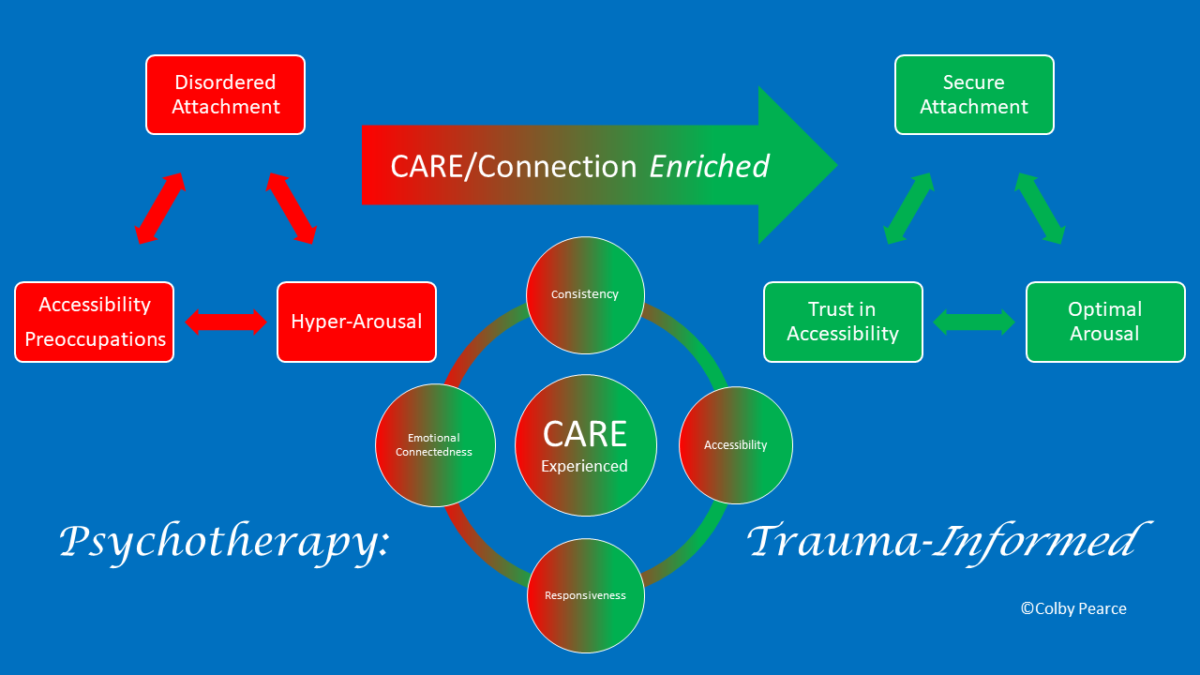
These areas of psychological knowledge are reflected in the Triple-A Model of Therapeutic Care, developed by Colby and first published in Educational and Child Psychology in 2010.
Triple-A provides a useful framework for thinking about three interrelated areas of a child’s experience.
Attachment
What might the child have learned about themselves, other people and relationships?
Children develop expectations about relationships through repeated experiences with important adults.
Where relationships have been sufficiently safe, available and responsive, children are more likely to experience other people as dependable and themselves as worthy of care.
Where relationships have involved disruption, loss, inconsistency, neglect, abuse or frightening experiences, children may develop different expectations about closeness, trust, dependence and safety.
Understanding these expectations can help make sense of how a child approaches relationships in the present.
Arousal
What might be happening in the child’s emotional and physiological state?
Children’s capacity to think, communicate, learn and respond flexibly is influenced by their state of arousal.
Some children become highly activated when distressed. Others withdraw, shut down or become difficult to reach.
Understanding the child’s emotional and physiological state helps us consider what the child may need before expecting them to think differently, talk about difficult experiences or use new skills.
Accessibility to needs provision
What might the child have learned about how important needs get met?
Children learn through experience whether adults notice their needs, understand them and respond reliably.
When needs have historically been met inconsistently or unpredictably, children may develop other strategies for attempting to secure what they need.
Some may intensify their behaviour. Some become highly controlling or persistent. Others may stop asking and become reluctant to depend upon adults at all.
Understanding these patterns can help us consider not simply what the child is doing, but what they may have learned through experience.
Looking beneath behaviour
Children’s behaviour makes more sense when considered in context.
Rather than beginning only with:
“How do we stop this behaviour?”
we are also interested in:
“What might be happening for this child?”
Behaviour may reflect emotional state, developmental capacity, expectations about relationships, previous learning, attempts to communicate needs, or strategies that once made sense in different circumstances.
This does not mean that all behaviour is caused by trauma, or that unsafe or harmful behaviour should simply be accepted.
Understanding behaviour gives us more information with which to respond.
Relationship as a therapeutic medium
The relationship between therapist and child is an important part of psychotherapy at Secure Start.
For some children, particularly those whose earlier experiences of relationships have been difficult, the experience of a reliable and interested adult can itself be significant.
For this reason, therapy is not always organised around a predetermined list of topics to discuss.
Colby may be guided by the child’s interests, play, activities, conversation and experience within the session.
What is discussed can be important.
But how the child experiences the interaction can be equally important.
Does the child experience the therapist as interested?
Available?
Curious rather than judgemental?
Able to tolerate difficult feelings?
Responsive?
Warm and emotionally connected?
Able to maintain appropriate boundaries without withdrawing from the relationship?
Able to reconnect when something has gone wrong?
These experiences form part of the therapeutic process.
Therapeutic responding and AURA
The contemporary Triple-A Model uses AURA as a framework for thinking about therapeutic responding.
AURA asks whether the adult is:
Accessible
Am I emotionally and physically available when needed?
Accessibility involves being present and approachable while respecting the child’s comfort with closeness and dependence.
Understanding
Have I tried to understand what might be underneath the behaviour?
Understanding involves remaining curious about the child’s experience rather than responding only to the surface form of behaviour.
Responsive
Did my response meet the child’s need in that moment?
Different moments call for different responses. A child may need reassurance, encouragement, practical assistance, co-regulation, space, playfulness, protection, structure or a clear boundary.
Attuned
Was I connected, warm and emotionally in sync?
Attunement involves noticing and responding to the child’s emotional experience and recognising when connection has been disrupted and repair may be needed.
AURA is not a therapy technique or a set of instructions for every interaction. It provides a framework for reflecting on the relational experience being created around the child.
The experience of therapy
For children, therapy does not always need to look like adults sitting together discussing problems.
Conversation, play, games, drawing, humour, shared activities and following a child’s interests can all provide opportunities for therapeutic work.
Activities can help children feel comfortable and engaged. They can also provide opportunities for the therapist to learn about the child’s approach to relationships, frustration, success, uncertainty, help, limits and emotional experience.
The activity itself may be less important than the experience that occurs around it.
A game, for example, can provide opportunities to experience an adult who is interested but not intrusive, competitive without humiliating, supportive when something is difficult, able to tolerate frustration, and able to share enjoyment.
These ordinary relational experiences can become part of psychotherapy.
Process as well as skills
Some forms of psychological therapy place considerable emphasis on teaching specific thinking, emotional-regulation or behavioural skills.
These approaches can be very helpful, and particular skills and strategies may form part of therapy at Secure Start where appropriate.
However, knowing a skill and being able or motivated to use it are not always the same thing.
For some children, developmental and relational work may be needed alongside explicit skills teaching.
Our approach therefore pays attention not only to what the child needs to learn, but also to the relational and developmental conditions that may help the child become more able to learn, trust, engage and use what they know.
Supporting positive developmental experiences
An important aim of therapy is to provide experiences that may contribute to more positive expectations about:
Self
Am I worthwhile? Am I capable? Do I matter?
Other people
Can adults be trusted? Will they help? Can relationships survive difficulty?
The world
Is the world always threatening and unpredictable, or can it also contain safety, enjoyment and opportunity?
Therapy also provides opportunities for children to experience support with emotional regulation and to learn that important needs can sometimes be communicated directly and responded to appropriately.
No single therapeutic interaction changes a child’s developmental history.
Repeated experiences can, however, provide opportunities for new learning.
Beyond the consulting room
Children spend only a small proportion of their lives in therapy.
Their most frequent developmental experiences occur within their everyday relationships at home, school and, for some children, foster, kinship or residential care.
For this reason, where appropriate and with relevant consent, therapeutic work may include consultation with parents, caregivers, educators and other professionals.
The aim is not to turn everyone in the child’s life into a therapist.
It is to help the important adults around the child better understand what may be happening and consider how everyday interactions can support the child’s development and wellbeing.
This is one reason the principles underlying Secure Start’s psychotherapy also inform the Triple-A Model of Therapeutic Care.
Therapy and Triple-A
Triple-A is a Model of Therapeutic Care, not a psychotherapy protocol.
It provides caregivers and organisations with a framework for bringing psychologically and developmentally informed thinking into everyday care.
Psychotherapy and Triple-A therefore have overlapping foundations but different purposes.
Within therapy, AAA can assist with thinking about the child’s experience, while the qualities represented by AURA are consistent with the relational environment we seek to create.
Within homes, schools and care settings, Triple-A helps the important adults in children’s everyday lives apply similar principles outside the consulting room.
This can support greater consistency between the child’s therapeutic work and the relationships and environments in which development occurs every day.
A developmental and relational approach
In summary, Secure Start’s approach to psychotherapy with children and young people is concerned with both what happens during therapy and how therapy is experienced.
We seek to understand the child in the context of development, relationships, learning and emotional state.
We place particular importance on relational connection.
We use activities, conversation and psychological methods flexibly according to the needs of the individual child.
We seek to provide experiences of accessibility, understanding, responsiveness and attunement.
And, where appropriate, we work with the important adults around the child so that helpful experiences are not confined to the consulting room.
The objective is not simply to change behaviour.
It is to support development, wellbeing, relationships and the child’s growing capacity to engage with the opportunities and challenges of life.
Learn more
Learn about the Triple-A Model of Therapeutic Care