Understanding what is happening for the child. Responding in ways that are therapeutic. Creating everyday experiences that support recovery and development.
The Triple-A Model of Therapeutic Care is an evidence-informed Model of Care for children and young people affected by adversity.
It provides caregivers, practitioners, teams and organisations with a practical framework for understanding children’s behaviour, emotions and relationships, and for considering how everyday caregiving can become therapeutic.
At the centre of Triple-A are two complementary frameworks:
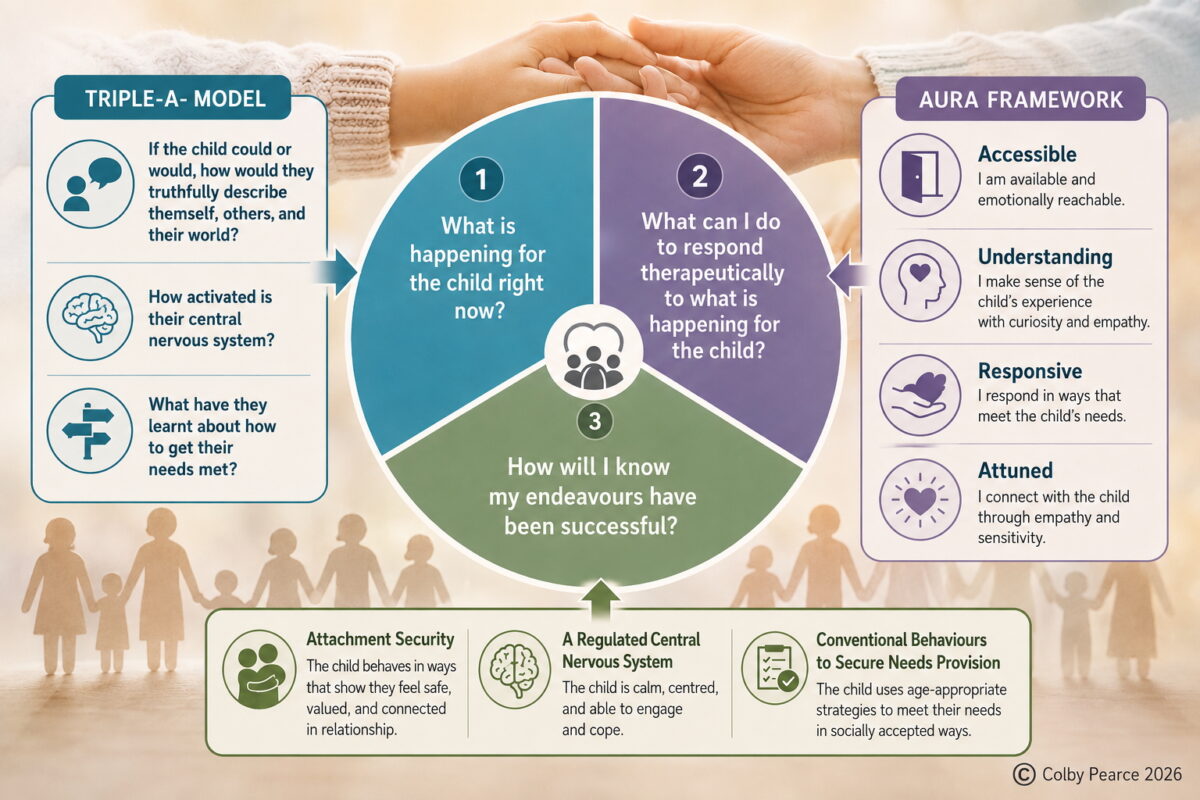
AAA helps us understand what may be happening for the child.
AURA helps us consider how we can respond therapeutically.
Together, they provide a shared language for therapeutic care that can inform everyday caregiving, reflection, supervision, care planning and organisational practice.
Understanding the child: AAA
Children’s behaviour does not occur in isolation. It develops within a history of relationships, experiences, learning and attempts to adapt to the environments in which they have lived.
Triple-A encourages caregivers to look beneath the behaviour and consider three interrelated domains.
Attachment
What might the child have learned about themselves, other people and relationships?
Children develop expectations about relationships through their experiences with important caregivers.
Where care has been sufficiently safe, predictable and responsive, children are more likely to experience other people as available and themselves as worthy of care.
Where caregiving has involved disruption, inconsistency, neglect, abuse, frightening experiences or repeated loss, children’s expectations of relationships may develop differently.
Triple-A encourages caregivers to consider how these relational expectations may be influencing what is happening now.
Arousal
What might be happening in the child’s emotional and physiological state?
Children’s capacity to think, learn, communicate and respond flexibly is influenced by their level of arousal.
Children affected by adversity may become highly activated in response to experiences that other people perceive as relatively minor. Others may withdraw, shut down or become difficult to reach.
Rather than considering behaviour independently of the child’s state, Triple-A asks caregivers to consider what may be happening in relation to stress, emotional arousal and regulation.
Accessibility to needs provision
What might the child have learned about how their important needs get met?
Children learn from experience whether important adults notice their needs, understand them and respond reliably.
When needs have historically been met inconsistently, unpredictably or only after behaviour becomes extreme, children may develop other ways of attempting to secure what they need.
They may become demanding, controlling, highly persistent or reluctant to depend upon adults at all.
Accessibility to needs provision brings a learning perspective to Triple-A. It encourages curiosity about what the child may have learned about getting their needs met and how new caregiving experiences might support different learning.
From understanding to therapeutic responding: AURA
Understanding is important, but understanding alone does not change a child’s experience.
The second part of Triple-A asks:
What can I do to respond therapeutically?
AURA provides four dimensions for reflecting on the experience we create for children through everyday caregiving.
Accessible
Am I emotionally and physically available?
Therapeutic care begins with availability.
Accessibility means being sufficiently present and approachable for the child while recognising that children differ in how comfortable they are with closeness, support and dependence.
For some children, discovering that an adult remains available without being intrusive can itself represent an important new experience.
Understanding
Have I tried to understand what might be underneath the behaviour?
Understanding means remaining curious about what the child’s behaviour may communicate about their experience, needs, expectations or emotional state.
It does not mean accepting unsafe behaviour or abandoning appropriate limits.
It means responding to behaviour while continuing to think about the child who is expressing it.
Responsive
Did my response meet the child’s need in that moment?
Responsiveness involves recognising what the child may need and responding in a way that is appropriate to the child, the situation and the relationship.
The most therapeutic response is not necessarily the same response every time.
Children may need comfort, practical assistance, encouragement, protection, space, structure, reassurance, co-regulation or a clear and safely held boundary.
Attuned
Was I connected, warm and emotionally in sync?
Attunement concerns the emotional quality of the interaction.
It involves noticing the child’s emotional experience and communicating, through words, tone, expression and presence, that their experience has been recognised.
It also includes recognising when connection has been disrupted and being willing to repair the relationship afterwards.
The therapeutic potential of everyday care
Triple-A is based on a simple but important proposition:
The ordinary experiences of care are also opportunities for therapeutic experience.
Getting ready for school. Sharing meals. Travelling in the car. Helping with homework. Saying no. Responding to distress. Celebrating success. Managing conflict. Going to bed. Reconnecting after something has gone wrong.
These moments occur repeatedly.
For children whose earlier experiences of care have involved adversity, they provide opportunities to experience something different: adults who remain available, seek to understand, respond appropriately and stay emotionally connected.
No single interaction transforms a child’s developmental experience.
But small experiences, repeated consistently over time, can matter.
What are we hoping to change?
Triple-A does not begin with the goal of simply producing compliant behaviour.
It asks a broader question:
How will we know our therapeutic endeavours have been successful?
Depending on the individual child, signs of progress might include greater capacity to:
- seek help from trusted adults;
- tolerate appropriate dependence;
- communicate needs more directly;
- experience relationships as safer and more dependable;
- recover following distress;
- accept support and appropriate boundaries;
- participate in everyday activities and relationships; and
- rely less upon extreme or unconventional strategies for getting important needs met.
These are potential indicators of therapeutic progress rather than guaranteed outcomes of Triple-A.
A Model of Care, not simply a training programme
Triple-A is intended to influence more than what individual caregivers know.
For a Model of Care to make a meaningful difference, it needs to become visible in what an organisation actually does.
Triple-A implementation therefore involves four related processes:
Foundation Training
Staff develop a shared understanding of Triple-A, AAA and AURA and begin applying the Model to their work.
Practice Integration
AAA and AURA become increasingly visible in everyday caregiving, reflection, supervision and decision-making.
Organisational Embedding
Leadership and organisational systems support Triple-A through areas such as induction, supervision, team reflection, care planning, workforce development and relevant practice documentation.
Fidelity and Continuous Development
Implementation is reviewed over time to identify strengths, support continued development and reduce the risk that the Model gradually becomes diluted or disconnected from its core principles.
Training introduces a Model of Care. Implementation is what makes it a Model of Care.
Evidence-informed and practice-tested
Triple-A has a peer-reviewed conceptual foundation and more than a decade of implementation in child and family services in Australia and Ireland.
The foundational Triple-A approach was published in Educational and Child Psychology in 2010.
Triple-A was subsequently implemented in foster care in South Australia and formally implemented and evaluated with TUSLA foster carers and professional staff in Donegal, Ireland.
A contextualised framework incorporating Triple-A principles was later implemented at scale through the South Australian Kinship CARE Project with the support of the Department for Child Protection.
The Model’s development has therefore been informed not only by theory and research but by sustained application in real-world caregiving systems.
Direct research concerning Triple-A remains at an early stage. Preliminary evaluation has demonstrated high acceptability and promising practice-based findings, but further independent research is required to establish effectiveness and child-level outcomes.
Triple-A is therefore described as evidence-informed rather than as an independently proven intervention.
The development of Triple-A
Triple-A has evolved through research, clinical practice and implementation since its original publication.
Earlier stages of its development included the CARE Curriculum, which organised therapeutic caregiving around Consistency, Accessibility, Responsiveness and Emotional Connectedness.
CARE informed significant implementation work, including the South Australian Kinship CARE Project and the later Martinthi Aboriginal Kinship CARE Program.
The contemporary Triple-A Model has consolidated this developmental work into two complementary frameworks:
AAA — understanding what may be happening for the child
and
AURA — considering how we can respond therapeutically.
CARE therefore remains an important part of the developmental and implementation history of Triple-A but is not a separate framework within the contemporary Triple-A Model of Therapeutic Care.
What Triple-A is not
Triple-A is not a diagnostic system.
AAA and AURA are not psychological tests or validated assessment instruments.
Triple-A does not suggest that all challenging behaviour is caused by trauma or attachment difficulties.
Understanding behaviour does not mean ignoring risk, abandoning boundaries or excusing behaviour that harms other people.
And Triple-A does not replace safeguarding, professional assessment, clinical treatment, cultural knowledge, statutory responsibilities or sound organisational governance.
Rather, it provides a framework through which caregivers and organisations can think more deeply about the child’s experience and the therapeutic potential of the care they provide.
Evidence & Practice Foundation
The evidence informing Triple-A extends beyond research conducted specifically on the Model.
Its foundations draw upon substantial external research concerning attachment, caregiver sensitivity and responsiveness, emotion regulation, co-regulation, foster care, relational intervention and therapeutic residential care.
The Triple-A Evidence & Practice Foundation distinguishes this broader evidence from research directly concerning Triple-A and from evidence arising from related implementations.
It also sets out the limitations of the current evidence and the priorities for future independent research.
Read the Triple-A Evidence & Practice Foundation
Download the Triple-A Model of Therapeutic Care – Evidence & Practice Foundation, Version 3.3
Triple-A training and implementation
Triple-A can be implemented as an organisation’s Model of Therapeutic Care, with training and implementation support tailored to the service context.
Implementation may include:
- Foundation Training
- implementation planning
- practice integration
- clinical and reflective supervision
- consultation concerning challenging cases
- organisational embedding
- implementation resources
- fidelity and quality review
- ongoing workforce development.
Triple-A can be applied across residential care and other settings in which adults provide sustained care to children and young people affected by adversity.
Enquire about implementing the Triple-A Model of Therapeutic Care in your organisation.